
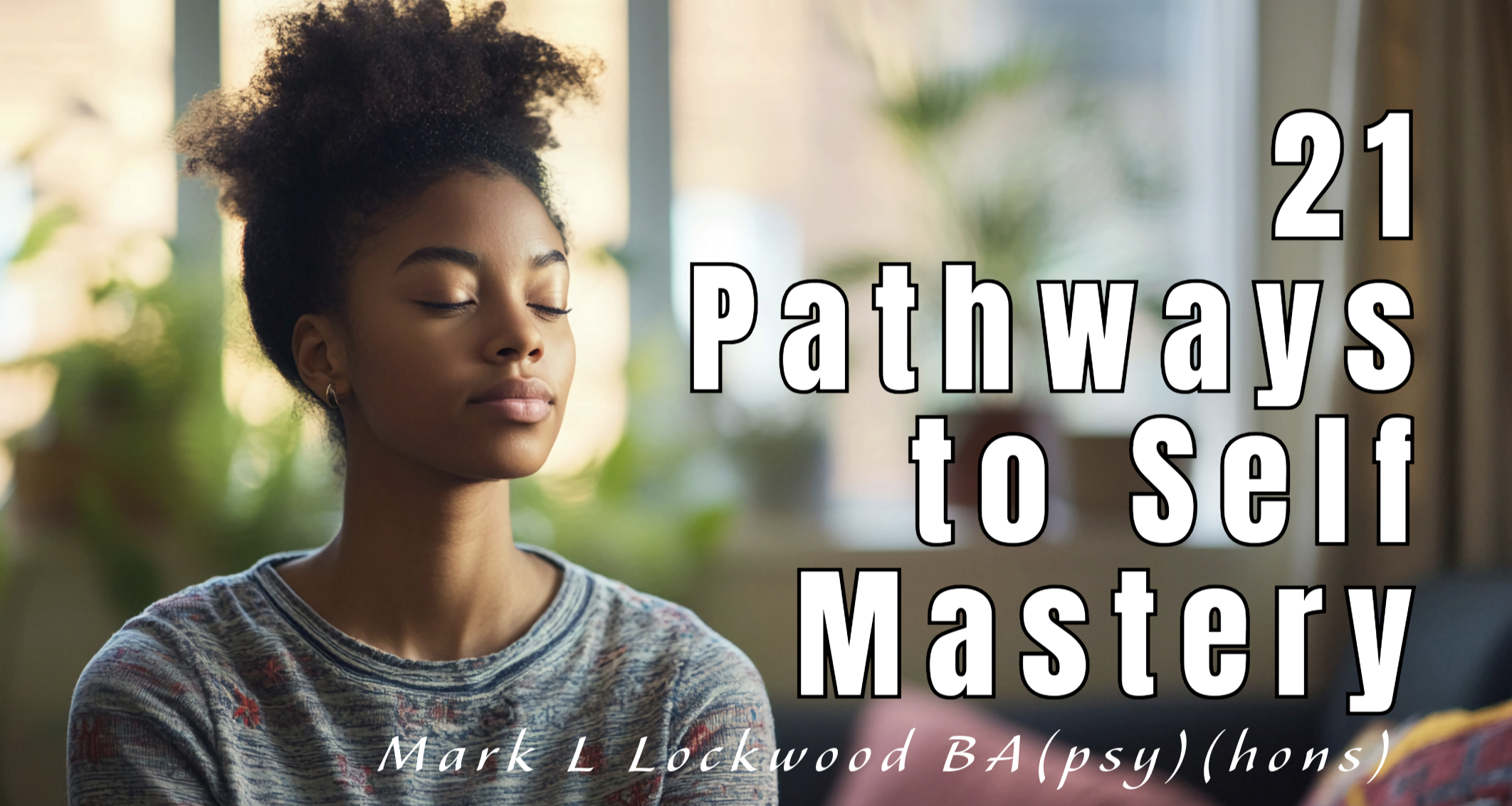
Mindfulness is a buzzword that has gained widespread attention, with people advocating for its benefits in overcoming addictions, anxiety, and depression. Others associate mindfulness as a part of finding themselves on their spiritual journey. Most individuals dealing with these issues find themselves in a state of feeling out of control and unhappy, generally anxious, and acutely lost in survival mind. These 21 Pathways to Self-Mastery are designed to help you create a mindful life from top to bottom and from the outside to the inside. Mindfulness is the art of bringing attention to the present moment, allowing individuals to confront reality and life’s gravity head-on without relinquishing to the body-heart-mind’s instincts to run and hide.
When you have cultivated self-mastery, you possess the power to govern yourself in any circumstance, propelling yourself forward with passion and determination towards your objectives. You are aware of your purpose and wield the self-discipline required to act deliberately, with unwavering focus and integrity. Let’s now delve into these 21 Pathways to Self-Mastery, igniting our passion as we practice the art of self-realization each day of our lives.
A modern definition of mindfulness
Mark defines mindfulness as a contemplative, conscious, physical and emotional way of being that is experienced within us. Inner experience is spiritual experience. Mindful states of consciousness are not dictated to us by the external environment or just the five senses associated with our bodily sensations, thoughts, feelings, and perceptions. When we move beyond the senses and our environment we operate with our Contemplative Intelligence (CQ) which is our ability to go beyond the judgments of the personality and the analytical mind so that we can access our extrasensory capabilities that allow us to see reality just as it is; without any distortions and projections.
To be mindful is to be contemplatively aware of everything (reality and truth untainted by egoic and dichotomous thought) which is God, self and other. To some they would call this the Universe; to describe one single everything. To be still and know that I am God. As stated above, mindfulness is about how we go inwards to get beyond the veil of the environment. The Psalmist in psalm 46 declared that no matter what was happening around him, God was his refuge and strength which is a brilliant example of mindfulness as an inner experience.

Mastering the Mind
The mind is a slippery little beast. It operates largely on memory and complicated neurological maps that allow you to navigate the world using past experience as your compass. Every heightened emotion in particular that you have ever experienced is an anchor that allows you to react with lightning speed to your external environment. It works like no one’s business. But like any super-computer, it has its flaws. The programs get old. Bugs develop. 21 Pathways to Self Mastery get us to be conscious that this whole slippery process exists and is not who we are. We are far more than mental processes. We are consciousness itself.
The primal defense system keeps out new experiences like any good antivirus software would, and change becomes the least important thing to do. Risk is eliminated where possible, and the unknown gives way to the mind’s need for constant certainty. Mindfulness gives way to a full mind, which paradoxically turns into mindlessness. Habitual programs become anxiety, stress, depression, and even personality disorders that lock us into running on autopilot. When we run on autopilot for too long, it’s just a matter of time before we get lost.
21 Pathways to Self Mastery
Here are 21 Pathways to Self Mastery that are simple to action in our everyday lives. Mindfulness is a practice, and if we want to play the guitar like Van Halen, we’re going to need a lot of practice. It is no different with our mindfulness practice. I suggest reading the Power of Contemplative Intelligence (CQ) to really dig deeply into mastering the mind. The book is summed up as the Science of finding your spiritual self and offers practical techniques to help you totally transform the body-heart-mind and return to the essence of your Soul or Sacred Self. In the meantime, let’s jump into the 21 Pathways to Self Mastery.
Pathway One: Master Your Mind
To transform your thinking and consciousness, it is essential to break the stream of thoughts and learn to respond rather than react. Mindfulness allows individuals to listen, think, and respond with clarity, openness, and honesty. We have all heard it said that you create your own personal reality with thoughts and beliefs, but you experience it through feelings and emotions. Change your thoughts, change your life, or when you change the way you look at things, the things you look at change. Know this, it is all true. When we get medical science to start allowing us to master our minds rather than try and get chemical assistance from the outside environment to do it for us, we will change the self, the world, and everything that is in it. Medication is great, but so is meditation. Mindfulness has a power that supersedes what medical science can do for us. Life is an inside job, and as we learn to master the mind, we start to see the evidence of miracles showing up more and more in our daily lives. As you begin to master the mind, an entire new world opens up in response.
Pathway Two: Master Acceptance
By accepting the present moment, whether it is good or bad, individuals can achieve inner peace and tranquility. Mastering acceptance involves acknowledging and embracing the reality of the current situation without seeking to change it. A great practice to master acceptance is to get beyond your story. The minds story of ‘his-story’ is ceaseless and starts to run the show. Imagine what things would be like if you accepted the situation. Use relaxation strategies, mindfulness practices, journaling, and self-reflection to understand your emotions. When we develop the mindful ability to stop automatic thoughts and ask ourselves who we are and how we feel and what we would do without traumatic, anxious or disturbing thoughts is essential in going beyond the mind, the veil of ignorance and the lies we may find we have believed that simply hold us captive and are not true.

Pathway Three: Master Awareness
By cultivating pure awareness and sharpening concentration, mindfulness enables individuals to become calmer, more productive, and successful. It encourages living in the present to foster a sense of contentment and well-being. Focusing on your attention, such as on your breathing, and developing a non-judgmental attitude. Mindfulness can help you increase your focus and adjust your thoughts. Add thoughts, feelings, perceptions and every other aspect of the self together and we have a whopping weapon for learning self mastery. When we align our faculties, our bodies, hearts and minds along with our intuition and intentions for example we find dormant power within that we may never knew existed before. Awareness, such like starting to deeply and contemplatively notice, is a gift!
Pathway Four: Living in the Present
Living in the present moment is an art that requires mindfulness practice. It involves focusing attention on the present reality and averting thoughts that lead to depression or anxiety caused by the past or worries about the future. Living in the present means being aware of what is happening right here and now. Including being aware that you are having thoughts about the past or the future. And knowing that they are just thoughts, not reality.
Pathway Five: Noticing
Noticing is an essential component of mindfulness, emphasizing the importance of being attentive and awake, rather than evading reality. It allows for an encounter with reality as it is. It gets its own category in our 21 Pathways to Self Mastery because it is so, so very powerful.
Byron Katie’s asks us “How much of your time is spent worrying, planning, stressing, reminiscing, daydreaming or ruminating? All those ‘things’ pull you away from the present moment. The truth is, there is magic happening in this very moment. This moment that will never be repeated. What are you choosing to notice today?”
Paying attention and noticing smashes our hyper-vigilance tendencies down to the ground. The mind is always looking for trouble and how to avoid it even if the trouble is not there. Over time this can turn into a gloomy feeling and then worse still it can become physically alive in our bodies. Noticing how amazing life is is not something that concerns the mind. Strange isn’t it? The mind clings to fear not bliss. Bliss is practiced through awareness, noticing and when we notice we fall into the gracious present moment, into gratitude, awe and wonder. All things the mind sucks at doing and all things we are amazing at doing when we become mindful that we an do them again. This is the art of contemplative practice we call living life through your Contemplative Intelligence (CQ). Notice that you have it and then use it.
Pathway Six: Master an open mind
Keeping an open mind is actually no easy task. We must replace an empty mind with an open one. It helps you to grow, strengthen self-reliance and especially an honesty that comes with an open mind. Open minds are truth seeking minds. Open minds are full, full of possibilities and realizations rather than rationalizations. Master an Open-Mind by being curious, asking open-ended questions, considering maybe instead of thinking you’re right and even allow your ideas to be challenged. It opens up empathy, encourages relationship building with others and allows people to hear what you have to share and vice verse. Open-Mind people are a rare find today so by becoming more self-aware, seeking out new experiences and perspectives, actively listening to others, and being willing to change our minds, we can become more open-minded and receptive to new ideas and ways of thinking.
Pathway Seven: Master Non-Judgment
The mind is a judging machine. It’s the nature of the mind to judge. Practicing non-judgment involves letting go of critical evaluations and embracing a balanced and open-minded perspective. It encourages stepping out of judgmental thinking to gain a clearer and more balanced view of the world. Non-judgmental people tend to not critique too quickly. The mind wants to pursue what it thinks is good, flee from what it thinks is bad and ignore everything else in between.
Some things are judged as “good”, so we grasp for more, and cling to what we have. Other things are judged as “bad”, so we hide, resist, and run away from them. As for everything that’s judged as “neutral” we ignore it entirely. This is how over time your Judge insurgent starts to ruin your life from the inside out. It is never happy, always critical and fault finding.
Pathway Eight: Letting Go of Control
Letting go of the need for control can lead to a sense of relief and peace as individuals come to terms with the limited control they have over various aspects of life.
Fear of change, loneliness, and fear of rejection, uncertainty, feeling of being judged or loss of control are based in fear. Fear builds our masks. One of our biggest fears becomes change, our fear of uncertainty, fear of failure, rejection, and even fear of missing out. Losing control or being judged keep us from showing our authentic selves. And if we’re not acting from a place of authenticity, we’re lying and nothing good comes from a lie. We’re not speaking the truth, and pain and suffering manifest soon enough. “I shall not lie” really means that we should not hide who we really are from the world or ourselves, for that matter.
Life refuses to be denied or held back for too long. The transformation to your Sacred Self will become necessary when you have endured enough suffering to let go of your need to control and let Life have you. Self love is the antidote for depression which is a state perpetuated by our incessant needs for control that are eventually turned inwards on ourselves.

Pathway Nine: Master Mindful Walking
Mindful Walking is something anyone of us can start at any time to begin a practice that is so simple, yet so profoundly powerful that the elixir of these two friends, along with the simplicity and the wholeheartedness it brings, can allow you to the space for necessary healing and personal growth.
Walk into the world every morning with intention, silence, gratitude and a deep sense of mindfulness. Allow the thoughts you have to ebb and flow as you start to learn about how to incorporate contemplative walking into your daily practice. Out goes the autopilot and in comes mindful mastery.
Mindful Walking or contemplative walking as Mark calls it is about not knowing just flowing, noticing everything as it is without deep thoughts or questioning. This in turn allows answers to flow to us as if they are spoken through some kind of ancient and silent language. It is one of the rare pleasures of life today that still costs nothing!
How you begin is by re-look at everything you see. Use short words like, tree, bird, water or warmth to describe the energy and delight your senses are taking in.
Flow. Allow nature to communicate with you in a holy and personal communion. Holy means sacred. Everything is sacred and holy, including you. Nature will help you in its depth and simplicity to be reminded of this.
Pathway Ten: Mindful vs. Mind-Full
Mindfulness teaches individuals to recognize when their minds are becoming overwhelmed with information, helping them to consciously choose to stop filling their minds with excessive thoughts and distractions.
Pathway Eleven: Master Anxiety
Mastering anxiety involves practicing techniques such as the 5-4-3-2-1 method, which helps to prevent catastrophic thinking and reduce the impact of anxiety attacks. Learning relaxation techniques can help you with the mental and physical feelings of fear through mindfulness practice. When you get down here in the doldrums, in the dungeons of the mind, which is your survival response, things start to happen to push you back up, and it’s love or suffering that is going to get you to the front. It’s love or suffering that is going to create spiral Dynamics that shift you one way or another.
This is how two paths diverge in a wood for all of us as the famous poem goes. Love and suffering are going to get you up and spiral you upwards towards growth, creativity, and contribution, where you move from a victim to a creator. So there is method to the madness when it comes to anxiety. To learn How to Heal Anxiety we need to know why it is here and what it wants from us. Nothing is random. Nothing.Master anxiety by becoming mindful of why it exists, what it wants to say and how you will get into agreement with it so you can make peace. Peace is anxieties antidote.
Pathway Twelve: Master the 5 Senses through 5-4-3-2-1
“Pratyahara” means “gaining mastery over external influences,” or, understanding & mastering the five senses. The 5-4-3-2-1 technique for example begins with deep breathing and progresses to acknowledging sensory perceptions in the environment, ultimately grounding the individual and providing relief from anxiety.
To effectively control your sense organs, you need to adhere to some simple mindfulness practices. Meditate daily, contemplate, notice, breathe, don’t react but respond, slow down and even stop smoking. You will experience bliss when you are centered in your innate, true nature which lies beyond the 5 senses you need to master to access your Sacred Self. First we master the 5 sensory and then that in turn opens the doorway to the extrasensory.
Pathway Thirteen: Making Mindful Decisions
Making mindful decisions involves a thoughtful and deliberate approach to decision-making, focusing on thoughts, feelings, and potential outcomes to ensure better, more balanced choices. Tony Robbins suggests 4 rules for decision-making:
- Rule 1: Write it down
- Rule 2: Get clear about your feelings
- Rule 3: Let go of fear
- Rule 4: Recognize your values
In addition to this, making mindful decisions involves being aware and halting action before starting. It’s about eliminating the continuous stream of automatic thoughts and embracing the discomfort of feelings.
While practicing the 21 Pathways to Self-Mastery, it’s important to let your feelings surface and simply hold mindful space, despite the temptation to distract, give up, or rush through, especially if these tendencies are habitual. Each decision should align not only with the sensory world of stimuli, thoughts, feelings, actions, and consequences, but also with our intentions, values, objectives, and ultimately, who we are and where we are headed. Often, these broader considerations are overlooked in our decision-making processes.
Mastering mindful decisions allows for significant, transformative changes in one’s life. Decision-making is a skill that can be practiced. It’s possible to become mindless, for example, while driving, preparing a salad, or missing out on the best parts of the day while ruminating over stressful events. These questions are essential in assisting us to make better decisions. Learn the art of making mindful decisions with these 4 steps before taking action.
Trust your intuition, your ‘inner-ding’ as we call it or your instinct in making right choices
Identify your real needs, values and priorities
Discover and evaluate options
Make decisions based on reality, not illusion
Pathway Fourteen: Mindful Everything
Make sure to have a mindful wind down before sleep. Eat, pray and then love all in on that order. Have a mindful wake up to start your day. Mindfully set your 3 best intentions, in the first hour of the day and write them down. Relax the body and do a 10 minute mindful mediation at least before arising. Deepak Chopra has suggested that sometime he does a couple of hours meditation before starting his day. Take mindful breaths. Check in mindfully in the day and at lunch time practice mindful eating. Then mindful walking. Remember the 3 second rule before you do anything. This will rewire your brain. Activate Your Mind and Your Muscles mindfully and stop with the autopilot.
Contemplatively read, view artwork and mindfully interact with nature. Do only what is in front of you when you feel overwhelmed and find a mindful rhythm. When we are mindful at a few things we will soon become Mindful at everything. Remember, what we do over there is more than likely what we will do over here. Pray mindfully at the end of the day and thank God for all that you have experienced in this brief, wild and wonderful ride called life.
Pathway Fifteen: Mastery and the Power of the Truth
Truth means reality. It is the place we are set free. Yes, the truth really does set us free and that has become more and more apparent over 23 years of helping people self actualise their full potential. Our life’s purpose is discovering the truth and the evidence for this is that we are all just becoming more conscious ever day of our lives. If you look at what happens in group therapy, or an Alcoholics anonymous meeting for example, is that you will see a bunch of people chipping away at the truth. Strangers help us reveal to ourselves the truth that lies below the masks of our personalities. The same thing happiness in a therapy office. All that people do is sit on the couch and talk until they discover the truth within, that has hidden dormant within all along. We are led to believe a lie and finding the truth is a natural progression through problems towards solutions. Mindful practice is being still, aware and present enough to allow truth to reveal itself.

Pathway Sixteen: Mastery Beyond Fear
Mindfulness encourages individuals to confront fear and anxiety as means of learning and growing, ultimately leading to a greater sense of freedom and control over emotional responses. Now we know we can practice massage, tai chi, yoga, mindfulness techniques, or meditation to help us move beyond fear but the real pathway back is found when we return to love. Love of self, health, wealth and world. Anxiety is separation from Love. So connection is how we develop Mastery Beyond Fear. All you need is Love!
Pathway Seventeen: Mindfulness over fear and Anxiety
Fear is a reaction to a current threat, while anxiety is a feeling of dread about a future threat. So we need to tackle both fear and anxiety with mindfulness. Some people might say that having fear and anxiety as a mindfulness mastery tool wouldn’t be a good thing and in fact any form of anxiety should be treated as negative. But to be honest without fear and anxiety you wouldn’t live very long at all. In the beginning of any growth process we normally suffer some sort of pain. We have growing pains so to speak and only thereafter, if we preserver through the initial pain do we get to a place of more contentment and more fulfillment and a higher consciousness and understanding which of course is probably a large part of what the meaning of life has to do with.
Listen. Mindfulness over fear and Anxiety is a choice. Choose wisely.
Remember that anxiety is something that is here as a messenger it is here to serve us and tell us to look out and be mindful and it can shout that from the mountaintops. Anyone who’s had panic attacks would know what that feels like. Becoming mindful of fear which is essentially returning to love. Fears opposite is love and further still it is a separation from love. I always say all anxiety is separation anxiety! It is separation from love, self and self-love for which our love for all other things is based. How we do self love is how we love others, how we love life and God. What we do over there is what we do over there and we need to be mindful of that and changes of what doesn’t work over there will help you change things that don’t work in other parts of your life.

Pathway Eighteen: Mindful Sensing
Practicing mindful sensing involves breathing methods, guided imagery, and other practices to relax the body and mind and help reduce stress. However that is just the doorway to the infinite, boundless spiritual self within. Mindful sensing is a type of meditation that involves being aware of your current feelings and sensations without judgment or interpretation. It’s a way to anchor yourself in the present moment and can help reduce stress. Mindful sensing is about maintaining a moment-by-moment awareness of our thoughts, feelings, bodily sensations, and surrounding environment, through a gentle, nurturing lens.
Stress is like that uninvited guest who just won’t leave. Mindfulness, on the other hand, can be the bouncer. It uses the five senses—sight, sound, touch, smell, and taste—to anchor us in the present moment. Once we are mindful and present we are able to practice contemplative practices that take us beyond the sensory into the extrasensory. We are all creatures capable of extrasensory mastery. Christ said that we will be able to move mountains with our believe and belief, intuition, imagination are all examples of the tools we have access to that are beyond our five senses.
Pathway Nineteen: Mindful Kindness
Kindness is portrayed as an act of mindful service and compassion, emphasizing the importance of self-care, self-discipline, and mindful consumption. One mindfulness practice called “Loving-Kindness” helps us cultivate an attitude of open, unconditional friendliness. This practice entails sending kind, compassionate or loving intentions/phrases to several different categories of individuals. I call this Metta. Metta meditation starts with the self and then pours out through the great chain of being through minerals, to other animals and people and then to God at the top, at the level of the Metta-physical. Kindness practices as we see them with our 21 Pathways to Self Mastery are concerned with altruism, generosity, and cooperation. Acting with kindness consistently over time leads to more happiness, better health, stronger, long lasting relationships and greater longevity. Now that is self-love in depth-right there! You can do a metta meditation here.
Pathway Twenty: Uncover the Beauty of Mindful Seeing
The art of “mindful seeing” resembles meditation, except it harnesses the power of sight to immerse oneself in the intricacies of a single moment. To embark on this practice, simply find a comfortable spot to stand or sit, and leisurely absorb the entire visual scene without rushing. Discard the tendency to mentally label or categorize the elements within your sight.
What sets the mindfulness practice of seeing apart is its reliance on extrasensory abilities, transcending the limitations of our basic five senses rooted in our individual makeup. Through “mindful seeing,” one can dedicate five minutes to gazing out of a window, perceiving the world as if for the first time. Instead of automatically pigeonholing or scrutinizing, we have the opportunity to mindfully behold birds, colors, shapes, distances, and even the proximity of our own nose – a detail often overlooked by the mind. By opting for mindful seeing, we shift from analysis to pure observation, allowing thoughts to flow more freely, unrestricted by the pursuit of solutions and the fixation on forthcoming challenges.
Pathway Twenty-One: Mastering Mindful Meditation
In some ways we have saved the best for last. Mindful Meditation like CQ meditation practices have been know to heal depression, anxiety, pain, and even major medical issues in short period of just a few weeks as we experience regularly at our mindful events and at our wellness center constantly.
Mindfulness meditation is a mental training practice that teaches you to start by slowing down racing thoughts. It teaches you to let go of negativity, and calm both your mind and body. It combines meditation with the practice of mindfulness, which can be defined as a mental state that involves being fully focused on the present so you can acknowledge and accept your thoughts, feelings, and sensations without judgment. Then CQ mindful meditation will take you beyond the 5 senses, beyond the minds need for certainty and then beyond your personality. Beyond your personality is where you will find your soul or your Sacred Self and Mark suggests that this is where change, transformation, spiritual awakening and miracle making happen.
Mindful Conclusions
Mindfulness has gained widespread attention for its benefits in overcoming addictions, anxiety, and depression. It is about bringing attention to the present moment and mastering the mind, acceptance, awareness, and non-judgment. The 21 Pathways to Self-Mastery guide individuals to a mindful life, incorporating practices such as mastering anxiety, mindful decision-making, and mindful kindness.
The 21 Pathways to Self Mastery short course we have gone through here concludes with an emphasis on mindful living, of advocating for presence, awareness, kindness, and compassion as essential tools for transforming one’s life. By practicing mindfulness mastery, individuals can embrace a path of self-discovery and lead a more deliberate and fulfilling life.
Mindful awareness is a key that we can learn to create for ourselves on a daily basis. Just 21 minutes a day of cultivating mindful awareness can change the way you see the world, and thus the way the world is projected back to you. Call it Karma, the law of attraction, yin and yang or whatever you prefer. Just know that “as you think, so shall you be”.
The 21 keys to mindfulness mastery take you on a journey about learning of the key of present moment mindfulness, mindful non-judgment and mindful letting go. Non of these need a rocket scientist to understand them. In fact all 21 keys to mindfulness mastery have been around for centuries. The good news, that proves their authenticity, is that they have not changed. That’s a sure fire way to test reality and keep the truth simple.
These 21 Pathways to Self Mastery that we have developed that can help us lead a mindful life of health and well being that impacts the world. Start your practice by using the Paradigm Process of Healing and Life Transformation.

Leave a Reply